

Hey rockstar,
In the last piece, we explored why AI “fast money” shortcuts leave so many people feeling numb, overwhelmed, and disconnected — and why the real foundation of a sustainable business is still connection, care, and community.
There’s a closely related piece almost nobody is talking about:
If numbness is what erodes your relationships, joy and wealth creation from the inside out, curiosity is what brings it back to life.
Not just as a nice idea — but as a literal learning rate for your brain and your purpose.
“Hey, before we jump in - when you get a moment, hit reply and tell me….
What’s the #1 thing you’re struggling with right now?
The Number That Should Stop Every Purpose Driven Wealth Creation - Cold
A developmental psychologist at Williams College tracked how many questions children ask per hour.
At age five, the average kid asks 107 questions per hour.
They’re relentless.
Why is the sky blue?
Why do dogs have tails?
Why does grandma’s hair turn white?
Their brains are running at full throttle, pulling in data from every direction.
Then school starts.
By first grade, the entire class asks 2.3 questions per hour — combined.
By fifth grade? 0.48 questions per hour. Less than one question every two hours from a room full of eleven-year-olds.

In one observation, kids were experimenting with an old-fashioned balance scale, genuinely doing science.
The teacher shut it down:
“Enough of that. I’ll give you time to experiment at recess.
There’s no time for experiments now. We’re doing science.”
Read that again. No time for experiments… during science class.
The researcher’s conclusion is brutal: if you lose your curiosity by age 11, you probably don’t get it back.
I disagree on one thing. I think you can get it back.
But you have to understand what curiosity actually is, neurologically.
And that’s where it gets interesting — especially for anyone trying to build something real in the AI era.
Your Brain Is a Large Language Model
(No, Really)
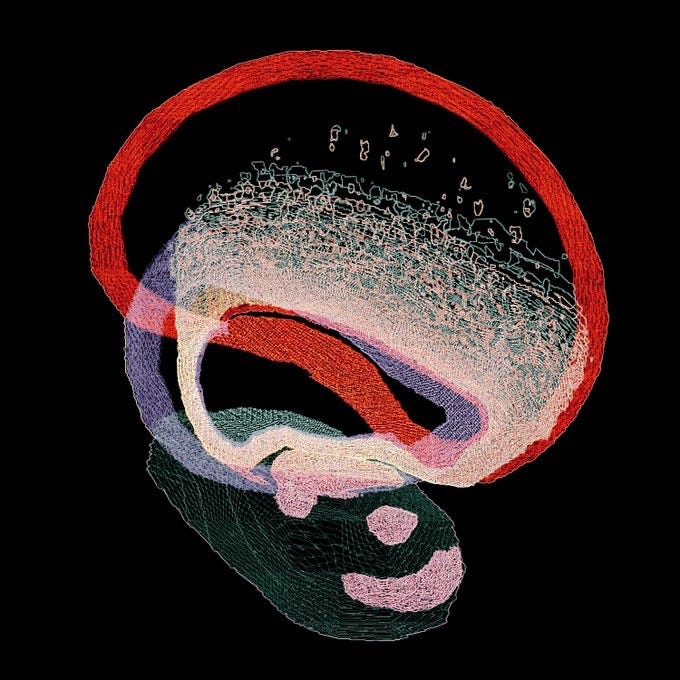
The more I create custom services and learn about how advanced AI models work, the more clear it becomes:
your brain is running the same basic algorithm.
Consider the parallels:
Your brain has roughly 86 billion neurons connected by an estimated 100 trillion synapses.
GPT-4 has approximately 1.8 trillion parameters across its mixture-of-experts architecture.
Both are massive pattern-recognition networks.
Both learn by prediction.
Here’s how an LLM trains:
it reads a sentence, predicts the next word, checks whether it was right, and adjusts its internal weights. Right answer? Strengthen that pathway. Wrong answer? Weaken it, try again. Billions of repetitions, trillions of adjustments.
Your brain does the same thing.
Every experience is a prediction.
You reach for a coffee cup and predict its weight.
You start a sentence and predict how the other person will react.
When reality matches your prediction, your synapses strengthen.
When it doesn’t, your brain recalibrates.
Neuroscientists call this predictive coding.
A 2024 study found LLMs become more advanced, their internal representations actually become more similar to human brain activity during speech processing.
Your brain is the original foundation model — pre-trained by evolution, fine-tuned by experience.
But here’s the critical difference:
An LLM’s learning rate is set by engineers.
They decide how aggressively the model updates its weights in response to new data. Too high and it’s unstable. Too low and it stops learning.
In your brain, that learning rate has a name.
It’s called curiosity. And unlike an LLM, you can adjust it yourself.
Curiosity as a Reward Signal: The Dopamine Connection
UC Davis put people in an fMRI scanner and asked them trivia questions.
What they found — published in the journal Neuron — changed our understanding of how curiosity works.
When participants were highly curious, their ventral tegmental area (VTA) and nucleus accumbens lit up.
These are the same brain regions activated by food, sex, and addictive drugs.
Curiosity hijacks your reward circuitry.
It’s not a nice-to-have personality trait. It’s a neurochemical event.

But the more interesting finding was this: during the curious state, participants were shown random faces, completely unrelated to the trivia.
Later, they remembered those faces significantly better than faces shown during low-curiosity moments.
Curiosity didn’t just help them learn the answer they wanted. It supercharged their memory for everything happening in that moment.
This is exactly how reinforcement learning works in AI.
When an LLM gets a reward signal through RLHF (Reinforcement Learning from Human Feedback), it doesn’t just strengthen the specific output —
The reward ripples through the network.
Curiosity is your brain’s RLHF. It’s the reward signal that tells 86 billion neurons: pay attention, something important is happening, encode everything.
Without that signal, your brain does what an untrained model does. It defaults to cached responses. You stop updating. You become, in AI terms, a frozen model.
Curiosity Literally Keeps You Alive
And this is about much more than learning faster.
In 1996, researchers Gary Swan and Dorit Carmelli at SRI International followed 1,118 older men over five years as part of the Western Collaborative Group Study. They measured curiosity at baseline and tracked who survived.
The result: highly curious people had significantly higher survival rates — even after controlling for age, smoking, cardiovascular disease, and other risk factors.
They replicated the finding in 1,035 older women.

Curiosity was directly associated with greater cognitive reserve — the brain’s buffer against age-related decline.
Curious brains keep building new connections. Incurious ones atrophy.
Mindset is a biological variable. Curious people don’t merely think differently — their brains physically maintain themselves better.
Which means in business terms:
The relentless drive to learn boosts your neurons and adaptability as much as any supplement or course.
How We Lose Curiosity (And Why That Kills Businesses)
We aren’t born numb.
However, school, social conditioning, and performance culture often suppress questioning. By the time most people start or grow a business, their curiosity has nearly vanished.
We learn to:
Stop experimenting unless there’s a guaranteed outcome
Protect what we already “know” instead of updating
Prioritize looking competent over actually learning
Layer AI “shortcuts” on top of that and the effect compounds.
You can ship more, post more, automate more — without ever engaging the deeper questions:
What is really happening in my market right now?
What are my clients actually struggling with beneath the surface?
Where am I out of alignment with what I’m selling?
Without those questions, your wealth stops evolving in any meaningful way. You may still be iterating on tactics, but your inner model of reality is frozen.
Numbness plus speed is just a faster way to hit the wall.
The most dangerous thing that can happen to your brain — or your business — is to stop being surprised.
How to Crank Your Learning Rate Back Up

Five strategies for creative agency:
1. Create information gaps intentionally.
Curiosity arises when you know enough to spot gaps but not enough to fill them. Before meetings, read halfway through an article and enter with questions, not answers.
2. Schedule daily “explore time.”
Dedicate 30 minutes to learning about unfamiliar fields to keep your curiosity alive without aiming for expertise.
3. Ask “dumb” questions among experts.
Genuine learners ask for explanations, even in rooms full of accomplished people.
4. Change your physical inputs.
Perceptual and intellectual curiosity; try new routes, restaurants without menus, or confusing places to stimulate dopamine.
5. Teach what you learn within 24 hours.
Sharing knowledge helps organize and consolidate it—similar to fine-tuning data in LLMs.
Curiosity, AI, and the “Whole Human”
In a world obsessed with speed and automation, the temptation is to outsource not just your tasks, but your actual thinking — your contact with reality.
But the future we actually want isn’t built by numbed-out operators running frozen mental models, propped up by ever-fancier tools.
It’s built by people who are:
Awake enough to notice when they’ve gone numb
Curious enough to re-open the questions about what they’re building
Grounded enough to use AI as support for their nervous systems and insight — not as a mask over their disconnection
That’s the through-line from the last piece to this one:
From extraction → to contribution
From performance → to presence
From “how do I hack the algorithm?” → to “how do I keep my own learning rate high enough to truly serve?”
What This Means for You
If you’re an entrepreneur:
Your competitive advantage isn’t your product. It’s your rate of learning. Build a culture that rewards questions over answers. Hire curious people over credentialed people.
If you’re an executive or practitioner:
Schedule one hour a week to explore a field completely outside your industry. Those who survive disruption are the ones whose mental models are still updating.
If you’re investing in yourself:
Bet on your curiosity the way a smart investor bets on a sole proprietor founder’s adaptability. Curiosity predicts adaptability — and adaptability predicts survival.
If you’re a parent or leader of others:
Count the questions in the room. If the number is dropping, the issue isn’t the people — it’s the environment. Protect spaces where real learning (which is always a little messy) is allowed.
The Invitation to the Deeper Mind
Let the FOMO cool.
Keep experimenting with AI — but pair every tool with a question:
What is this teaching me about my clients, my patterns, my assumptions?
Where am I tempted to go numb instead of stay curious?
Rebuild your foundation with timeless ingredients: connection, care, community, and a living curiosity that aligns you with life—not just trends.
Curiosity reconnects you with reality, countering numbness.
That’s how I use Generative AI in Oracle work:
To awaken intuition, not replace it.
When you open The Light Between Oracle, you enter an immersive experience blending symbolic language, somatic regulation, and guided integration—so insights land in your body, not just your mind.
Here’s the process:
You arrive scattered or braced.
The Oracle helps you downshift to hear yourself.
It reflects the clearest pattern at play.
You leave with one grounded step to take that day.
The goal isn’t more information—it’s becoming someone whose inner model continually updates through presence, questions, and authentic connection.

If you felt this piece in your bones, take the next step with me:
Try The Light Between Oracle here: [Insert your link to the Oracle app]
What you’ll get from it:
Clarity without overwhelm (a focused prompt + practical direction)
Nervous system replenishment (so your guidance doesn’t get drowned out by stress)
Better decisions through curiosity (questions that reopen your learning rate)
Aligned momentum (action that feels clean, not performative)
A daily wisdom + strategy practice you can actually sustain
If you want, hit reply and tell me what you’re navigating right now—and I’ll tell you the best place to start inside the Oracle.


